HTAG Copilot's AI-Powered Overhaul for Australian Property Advisors
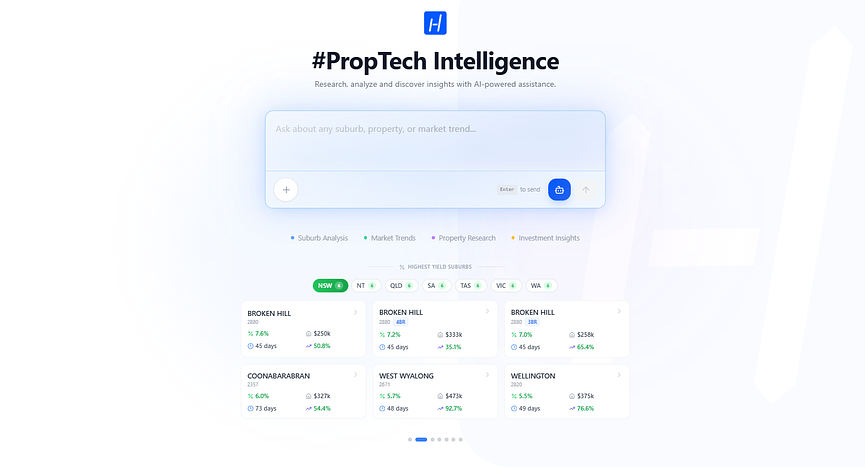
Australian property markets have always been data‑rich but decision‑poor. We’ve had access to feeds, dashboards and reports, yet most buyers agents and investment advisers still stitched everything together manually for each client.
HTAG Analytics’ latest overhaul of its Copilot platform directly targets that gap with a system built from the ground up for the Australian market.
This upgrade turns Copilot into an AI‑enabled property investment and client‑management environment, aligned with how Australian buyers agents, planners, and portfolio strategists actually operate day‑to‑day.
Context: where HTAG sits in the Australian PropTech stack
In Australia, most established platforms fall into three buckets:
Property management systems (e.g. PropertyMe, MRI, Console Cloud) focus on rent rolls, maintenance and compliance for landlords and PM agencies, not advisory.
Tax and portfolio apps (e.g. TaxTank, Growth Property) help individual investors track holdings and tax outcomes but do not manage multi‑client advisory workflows.
Horizontal AI tools (e.g. generic chatbots) can summarise text, but lack suburb data, portfolio context and Australian regulatory nuance.
HTAG Copilot is positioned squarely in the buyers agent and investment advisory lane. It blends Australian property data, portfolio intelligence and client management into one environment where AI is tightly coupled to local workflows rather than bolted on as a novelty.
Reasoning layer: from static lookups to Australian‑aware analysis
The most important architectural shift sits in the reasoning layer. HTAG has moved Copilot from low to medium and high reasoning capability.
In practice, that means:
The AI doesn’t just retrieve data; it queries HTAG’s knowledge base multiple times per task, each time pulling only relevant chunks.
It can handle compound Australian questions such as “Given this client’s portfolio and their goal to extract equity within 3 years, which properties are most exposed if rates rise another 100 bps?”
Reports can extend beyond 30 pages at high reasoning levels, with suburb‑level forward views (short, medium and long term), pass/fail calls for each property, and structured scenarios like “sell down underperformers vs hold and refinance”.
Client context: Australian portfolio management in one pane of glass
The new Copilot release introduces a more mature client context architecture designed for advisers handling multiple Australian clients and entities.
Core elements include:
Zapiio‑driven portfolio snapshot: Client holdings (by address, state, type) are visible inside Copilot, not hidden in a separate system.
Client workspace awareness: Once you’re in a given client workspace, all questions, health checks and suburb research are automatically scoped to that client.
Reassignable outputs: Reports and analyses can be reassigned to a different client from a dropdown—useful when a deal moves from one entity or spouse to another.
A structured Client Brief Builder capturing goals, constraints, timeframes and preferences, then injecting those into all AI reasoning for that client.
For Australian practices that handle couples, SMSFs, trusts and corporate entities, this system means less duplication and a cleaner audit trail of advice aligned to written briefs.
Portfolio Health Check: multi‑angle stress testing for Australian portfolios
The upgraded Portfolio Health Check is tuned for Australian lending, taxation, and market realities. Advisers can run multiple analytical “questions” on the same data set:
General Health & Stability – diversification by state and region, exposure to particular markets, concentration risk.
Growth Potential – alignment with historical and projected growth trends in each suburb.
Cash Flow & Serviceability – ability of the portfolio to withstand rate rises, rental shocks, or income changes under local lending settings.
The system presents results in categorized sections with visual progress cues while processing. It also supports:
Negative cashflow scenario analysis,
Comparative suburb rankings and stability scores,
Identification of key strengths and weaknesses across the portfolio,
Evidence‑backed recommendations on whether to hold, refinance, or sell and reallocate.
For a typical Australian investor with 3–8 properties across multiple states, this reduces what used to be hours of Excel work and portal‑hopping to a repeatable, documented workflow.
Research tools: suburb‑level analysis across Australian cycles
Research is where Copilot’s Australian focus becomes especially clear.
The Sold Property Search tool now includes:
Time filters (3, 6, 12 months etc.) that fit neatly with local valuation and lending practices.
Radius‑based search around a subject property, presented as an interactive map with property cards.
One‑click “Open in Google Maps” for on‑the‑ground context and an Excel export for offline modelling.
The Market Trend Tool extends the data lookback to about 10 years, essential for understanding how a suburb behaved through different RBA cycle changes, building booms and policy changes.
Through MCP integration, the AI can reason on these trends, highlighting inflection points or structural shifts in a suburb rather than just visualizing a line chart.
Planned template‑based analyses will standardise common Australian use cases, such as “equity extraction readiness”, “yield resilience”, or “rate‑rise stress testing”.
Reporting and communication: client‑ready for Australian advice practices
Copilot’s reporting environment has been substantially upgraded to make it easier to deliver and explain advice to Australian clients.
Key changes include:
A custom PDF viewer with side navigation for jumping between sections—valuable when presenting complex advice packs on a laptop or tablet.
Fully mobile‑optimised reports, recognising that many client discussions happen on the move.
Shareable report links, with white‑label capability on the roadmap, allowing firms to control branding while still leveraging HTAG’s analysis.
Data confidence indicators embedded throughout, helping advisers distinguish between high‑certainty historical data and lower‑certainty projections when talking to clients.
Report content now routinely includes:
· Portfolio vs Australian market comparisons
· Scenario analysis (e.g. “sell X, hold Y, buy Z”)
· Suburb‑specific assessments with pass/fail calls
· Holistic recommendations outlining “paths forward” for the investor.
Workflow and UX: built around a BA workday
The user experience work in this upgrade is deliberately practical.
Highlights:
A “morning dashboard” on login showing daily market stats, hot suburbs and key insights relevant to Australian investors.
A tabbed information panel (“notches”) that separates Research Results from Data Insights, reducing scrolling and cognitive overload.
A post‑it note style visual system that doubles as navigation on mobile, useful when advisers are on the road.
Chat upgrades including drag‑and‑drop file uploads with automatic vectorisation, voice‑to‑text, and clear visual indicators of where new content or insights are available.
The notification system further supports how Australian advisers work across time zones and commitments: in‑app alerts, default email notifications, webhook support for integrating with CRMs or task tools, quiet‑hour settings, and mobile push readiness.
Extensibility and white‑label: beyond the single practice
Two strategic elements in the upgrade will matter most for larger Australian firms and niche specialists.
1. Instrument Lab – a development‑only (for now) environment where custom analysis tools can be built and later exported as embeddable widgets via iframe. This allows a firm to:
Encode its proprietary frameworks (e.g. a specific risk model for regional assets),
Embed those tools on its own site for lead generation,
Still run them on top of HTAG’s data and AI infrastructure.
2. Sharing and white‑label – HTAG now supports sharing almost any insight as a branded “card”, with a free tier including HTAG branding and a paid tier allowing white‑label distribution. Planned dashboard features are explicitly designed for LinkedIn, Instagram and other marketing channels, so advisers can share “Australian market snapshots” that also showcase their expertise.
This dual structure gives Australian firms a pathway to turn internal process IP into client‑facing and marketing assets without building from scratch.
Looking ahead: memory, personalisation and predictive intelligence
The published roadmap extends the Australian focus further:
Memory activation will use past conversations to build psychographic profiles of clients—how they actually make decisions, not just what they say.
User profile injection will tailor the AI’s tone and depth to whether the user is a beginner, intermediate or veteran adviser.
Workspace and history enhancements will let teams return to prior analyses with full context preserved, critical for compliance and audit in an advice environment.
Taken together, these capabilities move Copilot towards a proactive system that flags portfolio issues or opportunities in Australian markets before the adviser asks.
Implications for Australian advisory businesses
For Australian buyers agents and property advisers, HTAG Copilot’s upgrade crystallises a broader shift. The conversation is no longer “Should we try AI?” but “How do we embed an Australian‑aware AI stack into our advice process before our competitors do?”.
By anchoring its platform in Australian data, workflows and market structures, HTAG has built something that sits between consumer‑grade tools and heavy institutional systems. For most local firms, that’s exactly where the opportunity lies: enterprise‑grade intelligence without enterprise overhead.
Explore HTAG Copilot and see the new features at www.htag.com.au